
Contents
1. Digifund sputtering target range
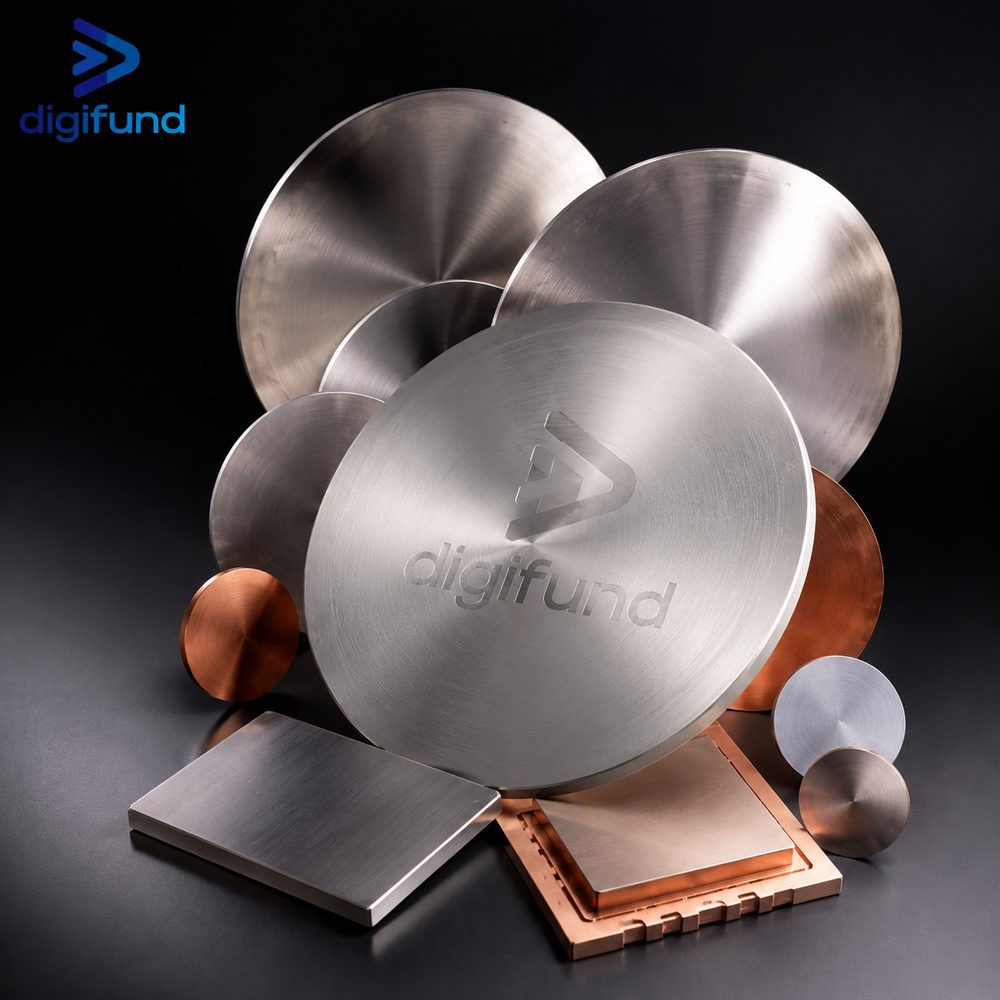
Digifund supplies sputtering targets for PVD thin-film deposition: metals, oxides and alloys, in round or rectangular form. The table below summarises the ranges listed in our catalog; configurations outside these values are quoted on request.
| Parameter | Catalog range |
|---|---|
| Material | Ti, Cu, Al, Au, Ag, Cr, Ni, Mo, W, Zn, ITO, ZnO, TiO₂, SiO₂… |
| Purity | 99.5% ; 99.9% ; 99.99% ; 99.999% |
| Diameter | 2" ; 3" ; 4" ; 6" (and rectangular targets) |
| Thickness | 3 mm ; 5 mm ; 6 mm |
| Shape | Round / Rectangular |
| Backing plate | Cu / In (optional) |
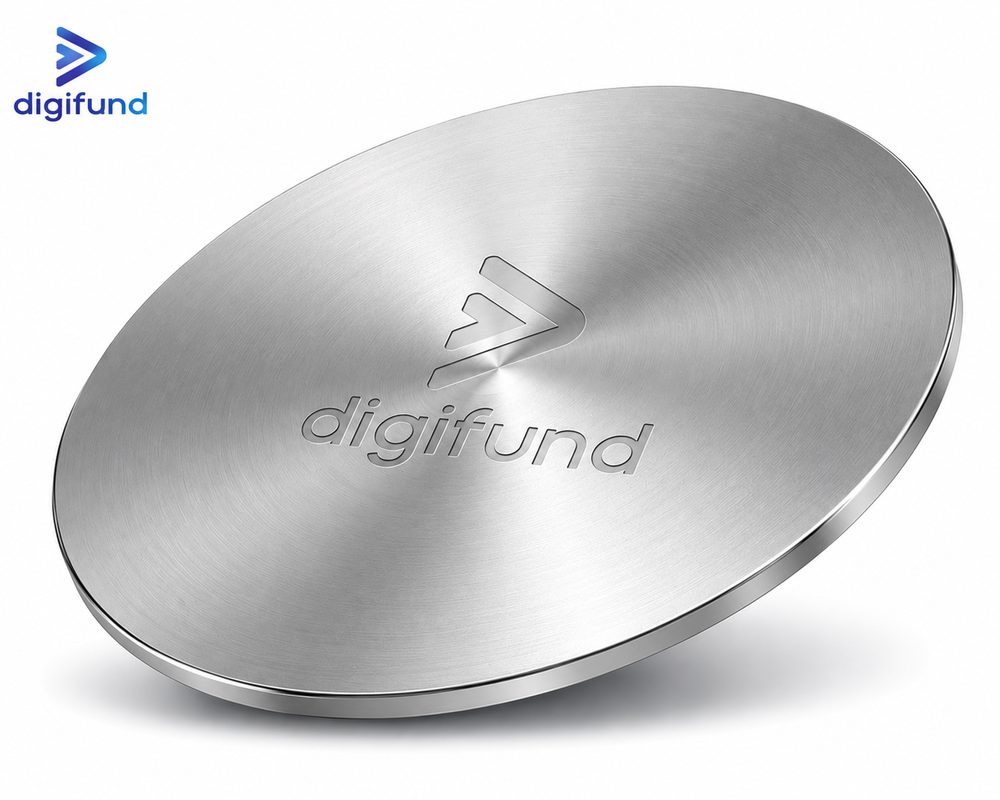
Catalog items with detailed specifications:
| SKU | Material | Purity | Diameter | Thickness | Shape |
|---|---|---|---|---|---|
| DG-ST-TI2099 | Ti (Titanium) | 99.99% | 2" | 3 mm | Round |
| DG-ST-TI3099 | Ti (Titanium) | 99.99% | 3" | 5 mm | Round |
| DG-ST-CU2099 | Cu (Copper) | 99.99% | 2" | 3 mm | Round |
| DG-ST-CU3099 | Cu (Copper) | 99.99% | 3" | 5 mm | Round |
| DG-ST-AL2059 | Al (Aluminium) | 99.999% | 2" | 3 mm | Round |
| DG-ST-AU2099 | Au (Gold) | 99.99% | 2" | 1 mm | Round |
| DG-ST-AG2099 | Ag (Silver) | 99.99% | 2" | 3 mm | Round |
| DG-ST-CR2095 | Cr (Chromium) | 99.95% | 2" | 3 mm | Round |
| DG-ST-MO2095 | Mo (Molybdenum) | 99.95% | 2" | 3 mm | Round |
| DG-ST-ITO3099 | ITO (In₂O₃:SnO₂ 90:10) | 99.99% | 3" | 5 mm | Round |
| DG-ST-ZNO2099 | ZnO | 99.99% | 2" | 3 mm | Round |
2. Evaporation materials: metal pellets and wire
Besides sputtering targets, Digifund's thin-film materials group includes materials for thermal and electron-beam (e-beam) evaporation. The two forms listed are metal pellets and metal wire, quoted on request.
| Form | Process | Specs to state when asking for a quote |
|---|---|---|
| Metal pellets | E-beam / thermal evaporation | Material, purity, pellet size (diameter × length) to suit your crucible or liner, weight |
| Metal wire | Thermal evaporation (boat, filament) | Material, purity, wire diameter, length or weight |
Whether evaporation or sputtering suits you better depends on the film and the equipment you have; if unsure, describe the film you need when you send your request.
3. Purity grades: what 2N5, 3N, 4N, 5N and 6N mean
The "N" notation counts the nines in the purity percentage. Each N step cuts total impurities by about ten times, and price usually climbs noticeably with each step.
| Grade | Purity | Maximum total impurities |
|---|---|---|
| 2N5 | 99.5% | 5,000 ppm |
| 3N | 99.9% | 1,000 ppm |
| 3N5 | 99.95% | 500 ppm |
| 4N | 99.99% | 100 ppm |
| 5N | 99.999% | 10 ppm |
| 6N | 99.9999% | 1 ppm |
Digifund's catalog lists 99.5% to 99.999%; the 6N row is for reference only. Two points to check on the analysis sheet: purity is usually stated on a metals basis, excluding gases such as O, N, C and H; and the method (for example GDMS or ICP) determines which elements were actually measured.
Choose the grade by application rather than "higher is always better": adhesion layers or trial coatings often use 3N–3N5, while electrical contacts and impurity-sensitive semiconductor or optical films need 4N–5N.
4. Planar or rotary targets
- Round planar targets — the most common form for magnetron guns in labs and R&D, named by diameter (2", 3", 4", 6").
- Rectangular planar targets — for rectangular cathodes on in-line or large-area coaters; ordered by length × width × thickness.
- Rotary (cylindrical) targets — the tube rotates around a fixed magnet, so it erodes more evenly and uses far more of its material than a planar target; it only fits systems with a rotary cathode, typically glass or solar coating lines.
The catalog currently lists round and rectangular targets. If your system uses rotary targets, send the drawing so Digifund can check supply. Why planar targets erode into a groove and use material poorly is explained in sputtering targets & thin-film technology.
5. Backing plates and bonding
Digifund offers Cu backing plates and In bonding as options. Whether to bond depends on the material and on how your gun cools the target:
- Ductile metals (Cu, Al, Ti…) — often usable unbonded (monolithic) if the gun clamps the target directly and cools it well.
- Ceramics and oxides (ITO, ZnO, TiO₂, SiO₂) — brittle, poor heat conductors and prone to thermal-shock cracking; bond them to a Cu backing plate for support and heat removal.
- Thin precious-metal targets (for example 1 mm Au) — thin targets save material but often need a backing plate for stiffness and to reach the thickness the gun expects.
With a bonded target, the total thickness (target + bond layer + backing plate) must sit within the gun's clamping range. The pros and cons of each bonding method are covered in our sputtering target article.
6. Target size must match the sputtering gun
- Diameter follows the cathode. A 2" gun takes a 2" target, a 3" gun a 3" target. Some guns use a close metric size (for example 50 mm instead of 50.8 mm), so measure your old target or check the gun manual.
- Thickness within the gun's range. A target that is too thick will not clamp or weakens the magnetic field at the surface; too thin and it needs replacing soon.
- Magnetic materials (Ni, Fe, Co) need thinner targets. A magnetic target shunts the magnetron's field, so it usually has to be thinner than a standard target or run on a strong-magnet gun.
- Larger systems, larger targets. 4" and 6" targets usually go with systems coating larger substrates; to choose or upgrade a sputtering system, see cleanroom equipment & sputtering systems.
7. What to send for a quote
Send the details below to get an accurate quote the first time:
- Material and composition (for alloys or mixed oxides, state the ratio, e.g. ITO In₂O₃:SnO₂ 90:10).
- Required purity (e.g. 99.99%).
- Shape and dimensions: diameter or length × width, thickness, tolerances.
- Backing: unbonded, Cu backing plate, In bonding; attach the backing drawing if you have one.
- Make and model of the sputtering system or gun, DC or RF power — see how to choose DC or RF by material.
- Quantity, documents you need (e.g. an analysis sheet) and when you need the goods.
8. Receiving, storage and installation
- Inspect the packaging and target surface on arrival; for ceramic targets, look for cracks or chipped edges.
- Wear clean gloves and never touch the sputtering face; skin oils and salts end up in the film.
- Store in the original sealed bag (vacuum or inert gas) in a dry place; let the bag reach room temperature before opening to avoid condensation.
- Keep the label and lot number so you can trace problems in the film.
- Mount with the correct clamping torque and good contact to the cooled surface; ramp power up slowly on ceramic targets.
- Pre-sputter with the shutter closed before the first deposition to remove the surface oxide.
Frequently asked questions
Does Digifund sell sputtering targets in Vietnam?
Yes. Digifund supplies metal, oxide and alloy sputtering targets such as Ti, Cu, Al, Au, Ag, Cr, Mo, ITO and ZnO, at 99.5% to 99.999% purity, 2" to 6" diameter or rectangular, with optional Cu backing or In bonding. Send your specifications for a quote.
What is the difference between 4N and 5N targets?
4N is 99.99%, with total impurities up to about 100 ppm; 5N is 99.999%, about 10 ppm. 5N is needed for impurity-sensitive films such as electrical contacts or semiconductor layers; for adhesion layers or trial coatings a lower grade is usually enough and cheaper.
What information is needed to quote a sputtering target?
Material and composition, purity, shape and dimensions (diameter or length × width, thickness), backing or bonding requirement, sputtering gun model, DC or RF power, quantity and when you need the goods.
Need a sputtering target quote?
Send the material, purity, dimensions, backing requirement and sputtering gun model; Digifund's technical team will check the configuration and send you a quote.
Request a quote View fabrication materials